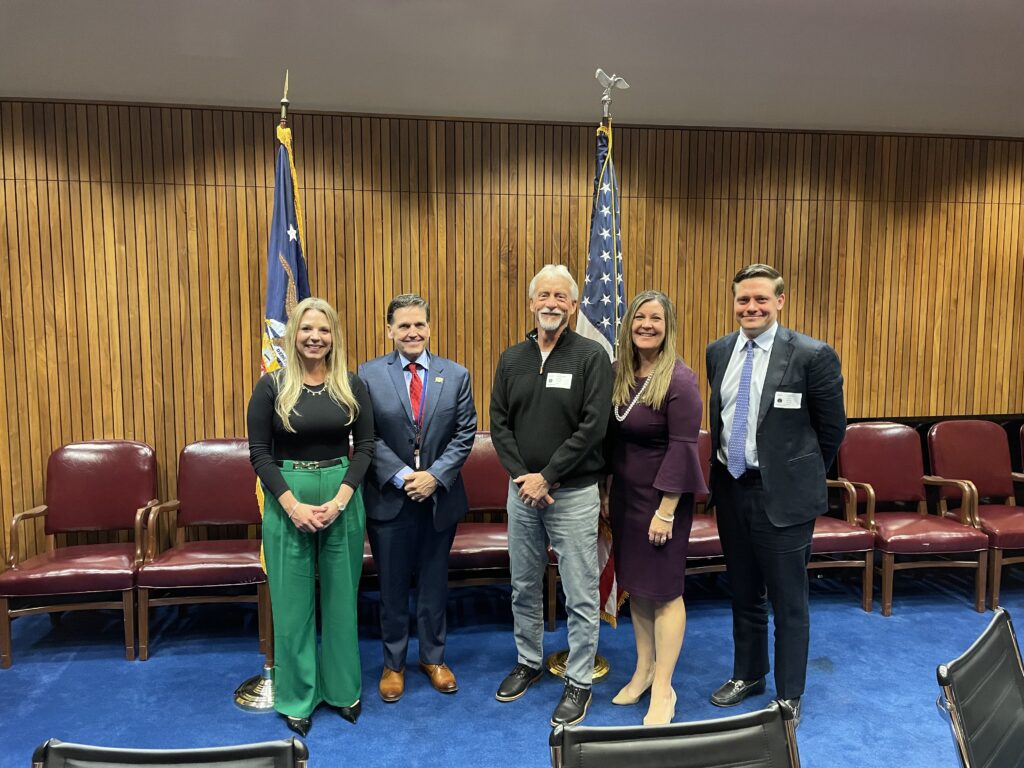
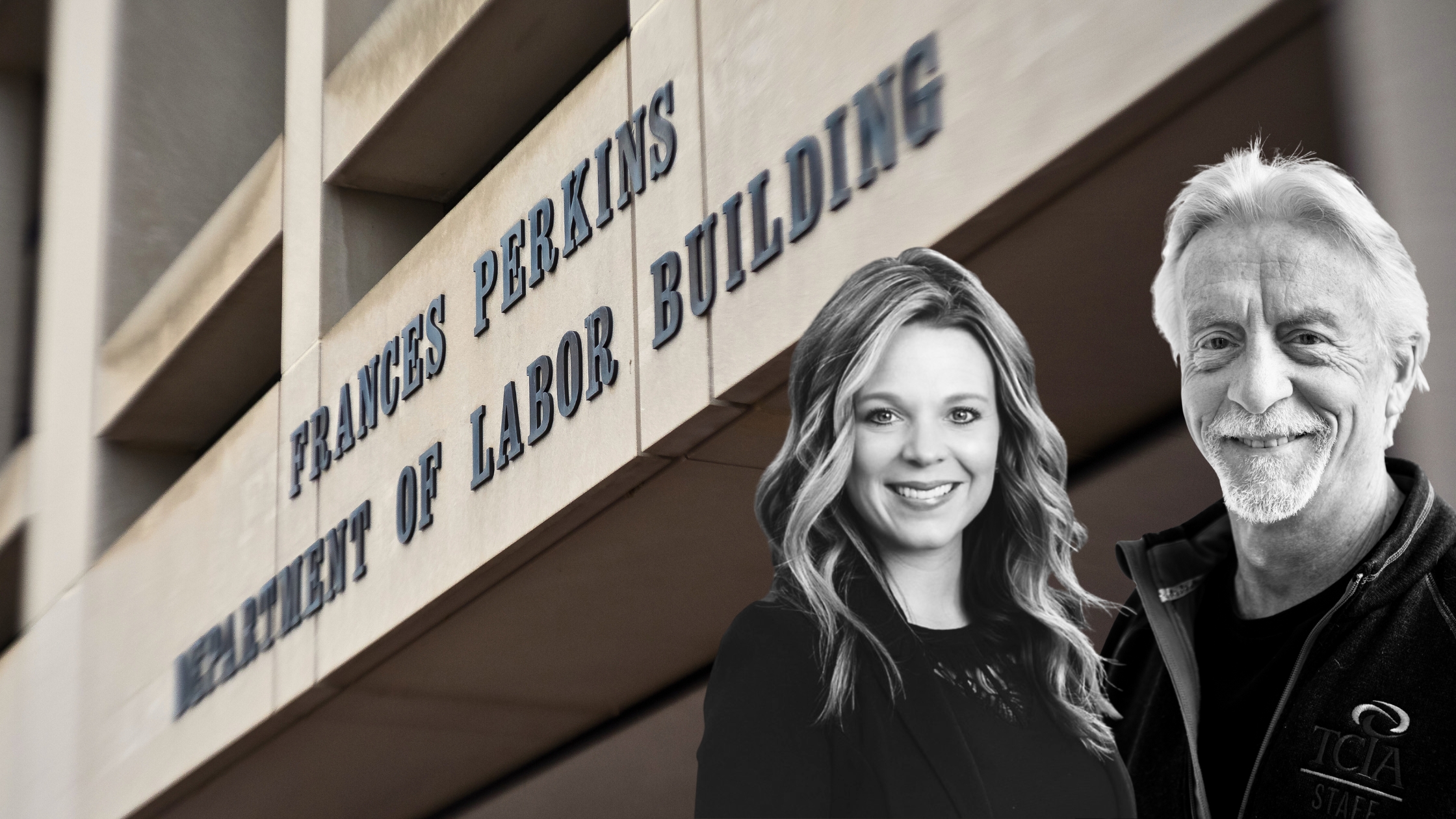
On December 18, TCIA’s Peter Gerstenberger and TCIA Board Senior Director Amy Burkett met with David Keeling, the newly appointed Assistant Secretary of Labor for the Occupational Safety and Health Administration (OSHA), at the agency’s Washington, D.C. headquarters. This important meeting represents TCIA’s ongoing commitment to advocating for tree care professionals at the federal level.
Currently there is still no federal tree-care-specific standard. TCIA’s objective with its core message is persuading OSHA to adopt a single, coherent regulatory framework that enhances worker protections while providing clarity to both OSHA and the regulated community.
Working alongside Ulman Public Policy, TCIA has developed targeted talking points to ensure the tree care industry’s perspective is clearly communicated to OSHA leadership.
“We’ve been working a long time to get this standard passed,” said Peter Gerstenberger, Senior Vice President, Industry Expertise, TCIA. “This standard gives clarity on industry best safety practices to OSHA, employers, and employees, and reduces the risk of illness and injury within our industry.”
This meeting is part of TCIA’s behind-the-scenes work to represent member interests in Washington. Secretary Keeling was confirmed by the Senate in October and brings fresh leadership to OSHA—making this an opportune time for TCIA to engage on industry-specific safety standards.
See the key points below.
Click here to see all of TCIA’s efforts to advocate for the tree care industry.
KEY POINTS AT A GLANCE
- Tree care is a high-hazard profession. Fatality rates are estimated at 10–30 times the national average, and more than 1,000 injuries occur annually. A Tree Care Operations Standard is fundamentally about reducing these incidents.
- OSHA’s current approach is a patchwork. Tree care is regulated through multiple ill-fitting rules developed for other industries. This leaves employers and workers without clear, tree-care-specific guidance on the leading causes of serious injury and death. At the same time, it severely hampers the efficiency and effectiveness with which OSHA field compliance personnel can adjudicate safety issues when they visit a tree care worksite.
- A tree-care-specific OSHA standard improves safety. A standard grounded in ANSI Z133 would provide clear, practical, enforceable requirements tailored to our industry’s unique hazards and directly target the leading fatal injury sources.
- A tree care rule functions as a deregulatory action by streamlining the existing regulatory scheme OSHA imposes on companies. It would replace the current patchwork with a single, coherent framework—reducing confusion and improving regulatory clarity while enhancing worker protection.
- The rule is overdue and procedurally ready. The last major procedural step, the SBREFA panel, was completed in 2020 during the first Trump Administration and produced clear recommendations. OSHA now has the record and stakeholder input it needs to issue an NPRM.
- Bipartisan support in Congress. It has consistently garnered bipartisan support from Congressional committee leaders with OSHA oversight.
- Our ask: Meet the April 2026 Unified Agenda target for the NPRM, grounded in ANSI Z133 and SBREFA recommendations, including recognition of safe, widely used practices such as crane access.
- TCIA stands ready to assist: TCIA and its members can provide technical expertise, data, and field demonstrations to support OSHA in crafting a practical, protective, and streamlined standard.
Who We Are/What We Do
- TCIA represents 1,400 commercial tree care companies nationwide.
- Collectively, our members employ more than 150,000 workers—an estimated 75% of all tree care workers in the country.
- Companies protect homes, businesses, and communities by managing trees around critical infrastructure (powerlines, roadways), performing wildfire prevention work, providing storm-response and recovery after hurricanes, winter storms, and tornadoes, and caring for the health and beauty of natural spaces.
- Tree care is a high-hazard occupation, and improving safety has been central to TCIA’s mission for more than 80 years.
Why This Standard Matters
Safety
- The fatality rate for tree workers has been estimated at roughly 10–30 times the all-industry average, and more than 1,000 tree workers are injured every year on the job
- The most serious hazards in tree care are well understood and preventable.
- Struck-bys / contact with objects or equipment (especially falling trees and limbs)
- Falls from height (mostly from or with the tree or aerial lift)
- Electrocutions (direct or indirect contact with electric current)
- Since the early 70s, the industry has used ANSI Z133 and TCIA training/credentialing as the de facto safety framework. Employers and workers are asking for an OSHA rule to reflect this reality.
Current approach – recognized high hazard, but a patchwork
- OSHA clearly recognizes tree care as high-hazard: there is a national citation directive and multiple Local/Regional Emphasis Programs focused on tree work.
- But there is still no tree-care-specific standard. Instead, OSHA relies on:
- General industry standards, not written for arborist work, and
- The General Duty Clause (GDC), when no specific rule fits.
- In FY 2024, the General Duty Clause was the most frequently cited OSHA provision in tree care inspections, used to address hazards already covered in ANSI Z133, indicating that inspectors are frequently turning to the GDC because there is no dedicated standard for tree care operations.
- Crane access illustrates the limits of the current framework: a method recognized in ANSI Z133 and several OSHA-approved State Plans as one of the safest ways to access trees is still regulated unfavorably under general-industry crane rules, creating regulatory uncertainty around a well-established, safety-driven practice.
One rule that improves safety and simplifies compliance
- A Tree Care Operations Standard would replace OSHA’s current method of regulating tree care through multiple, ill-fitting rules and guidance from other industries with a clear, consistent standard tailored to the industry’s unique hazards.
- It would focus directly on the leading causes of serious and fatal incidents in tree care (struck-by, falls, electrocution), rather than relying so heavily on after-the-fact General Duty Clause citations.
- By consolidating and improving upon existing requirements, it would reduce confusion and compliance burdens for employers and inspectors, and should be understood as streamlining and clarifying how OSHA regulates tree care, not creating an entirely new layer of rules.
History, Timing, and Congressional Interest
- TCIA formally petitioned OSHA in 2006 to develop a Tree Care Operations Standard.
- Since then, OSHA has:
- Held stakeholder meetings and published an ANPRM; and
- Completed a SBREFA panel in 2020, recommending alignment with ANSI Z133 and permitting employers to follow the industry practice of hoisting personnel with cranes in connection with tree care work.
- The target date for issuing an NPRM has been postponed multiple times on the Unified Agenda.
- The Spring 2025 Unified Agenda set a new target date of April 2026 for publication of the NPRM, giving OSHA a renewed opportunity to make meaningful progress on this long-standing priority.
- Congressional interest has been sustained and bipartisan.
- For more than 25 years, Members of both the House and Senate—on a bipartisan, bicameral basis—have urged OSHA to move forward.
- Members of both the House and Senate have sent letters in 2024 and 2025 urging OSHA to prioritize the Tree Care Operations Standard and align it with ANSI Z133.
Our Ask & How TCIA Can Support OSHA
- Our Ask
- Meet the April 2026 Unified Agenda target by issuing a proposed Tree Care Operations Standard.
- Base the NPRM on ANSI Z133 and the 2020 SBREFA recommendations, including clear treatment of safe, widely used practices such as crane access.
- How TCIA Can Support OSHA
- Provide technical expertise and field-based examples drawn from companies of all sizes.
- Share industry data and experience on fatalities, injuries, and effective controls.
- Help facilitate demonstrations of safe practices, including crane access, so OSHA staff can see how the work is performed in practice.
- Continue to serve as a constructive partner as OSHA develops a standard that is practical, achievable, and protective—while consolidating and improving upon the existing, fragmented regulatory framework.